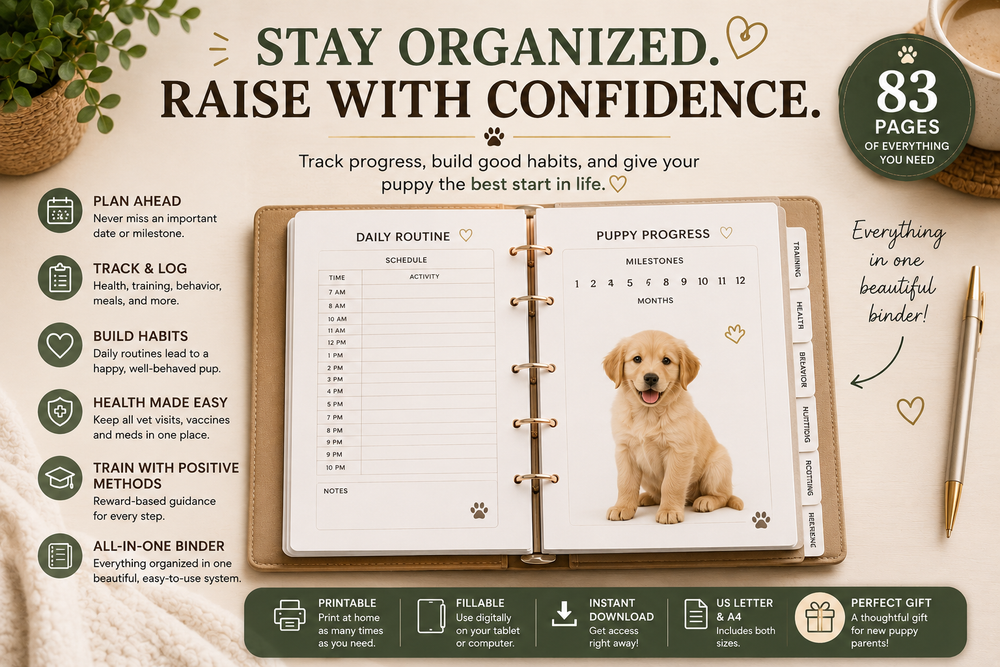
The Puppy's First Year Binder – Your Complete Puppy Planner & Training Companion
Your puppy's whole first year, decided in advance.
An 83-page handbook, training journal and record system for the twelve months that shape your dog for the rest of his life.
 Get the binder — $7
Written around published guidance from the AVSAB, AVMA, WSAVA and AAHA — every source listed at the back of the binder.
It's 2 a.m. and you're googling again.
Is this biting normal? Should he still be crying in the crate? Have I already missed the socialization window?
Every answer contradicts the last one. Meanwhile the most important weeks of his life are going by, and nobody is keeping track of them but you.
I didn't need more advice. I needed one place where everything lived.

When our puppy came home, I thought the hard part would be the sleepless nights.
It wasn't.
It was trying to remember everything. When he last ate. How long he slept. Whether that was the second accident or the third. And every question I meant to ask the vet, forgotten by the time I got there.
After a few chaotic weeks I realised I didn't need more advice. I needed one place where everything lived. So I built it.
Health records, routines, training, milestones — and all the small details that stop fitting in your head once life with a puppy gets busy.
I hope it buys you what it bought me: less time worrying about staying organised, and more time actually enjoying his first year.
One binder. Twelve months. In order.
A binder that walks the twelve months with you in order — what to expect, what to do this week, and a page to write down what actually happened. Print it, or fill it in on a tablet.
A companion, not a manual
Written in order, from before he arrives to his first birthday. You are never looking for the right chapter.
Somewhere to write it down
Eleven trackers and dozens of fillable pages. The record builds itself as the year goes by.
An answer when it stops being fun
Four decision trees and a troubleshooting entry for every complaint owners actually have.
Eighty-three pages. No filler.
Eight parts, below. Everything inside a framed box is lifted straight out of the binder — either the page itself, or its content reproduced here. The label at the top of each box tells you which page it came from.

The week nobody warns you about, hour by hour.
Room-by-room puppy-proofing, the four zones, the first night, and a printed day plan built around the one thing that fixes most "impossible" puppies: sleep.
The four figures printed at the foot of the daily rhythm page.

Naps shaded. Half a puppy's day is sleep — that is the page.

Two minutes an evening, and your vet can read it.
Eight categories, fourteen weeks, one grid.
This is the part of the year you cannot do again. Each category gets its own page — why it matters, how to introduce it safely, what to record — and every item is checkable.
Each of the eight gets a full page of its own.
Three of the eight. Every category page ends with one small action.
Reproduced in full — this is the complete table from the page.

Eight categories across fourteen weeks. The empty squares are the point.
Stop guessing why the accidents happen. Find the pattern.
Mark the hour and the room every time. After two weeks the shape on the page tells you what to change — and the binder tells you what each shape means.

One mark per accident, by hour and by room.
The interpretation key printed underneath the grid — all five rows.
Everything runs on one loop.
Understand it once and you can teach anything. Seven core cues, progression meters for handling, crate, lead and recall, and a training log that fits on one line a session.
The four-step loop everything else in the chapter runs on.
Every chapter closes with one action you can take before the day ends.
Everything the vet asks for, already written down.
Vaccination record, growth chart, symptom and medication log, food and weight log, first-response pages, and an insurance comparison grid.

Twelve months of weight on a single page.
One of dozens of reference tables in the binder.
Four decision trees, for when you need an answer and not an article.
Biting, separation, fear, and the one question every owner asks at midnight. Each tree ends on one of four outcomes.
The same four outcomes appear on every tree and every entry.

Follow the questions down. Four possible outcomes.

Page four, deliberately. For the bad days.
Reproduced exactly, including the instruction not to use the page.
Word for word, for the conversations that decide how your puppy is treated.
Nobody else puts these in a puppy book. They are the pages owners come back to most.
Straight from the index page at the back.

What to say, and what to bring.
The chapters most puppy books stop before.
A budget planner you fill in with your own currency. Months six to twelve, where most owners quietly panic. And a twelve-month review to fill in on his birthday.

Your figures, your currency. Setup, monthly, and M1–M12.
Two of the chapters most puppy books stop before.
Every tracker, tree and script — and its page number.
The index page from the back of the binder, reproduced in full. Nothing held back.
All eleven, exactly as listed at the back of the binder.

The whole index page, so you can check the list yourself.
What each page actually does for you.
No reviews yet — so here is what the binder is built on instead.
This was published this month. Rather than borrow anyone else's numbers, here is exactly where the guidance comes from — and you can check every one.
The full reference list is printed at the back of the binder.
The pages you did not know to ask for.
All included — nothing here is a separate purchase.
Cut-out emergency cards
Four cards to cut along the lines: never let him eat, suspected poisoning, heatstroke, dehydration. One for the fridge, one for the car.
The pet sitter handover sheet
One page that tells whoever has him everything they need, so you can leave for a weekend without a phone call.
The milestone & memory pages
Week 8, week 16, month 6, month 12. Weight, favourite toy, biggest success, and space for a photograph.
The family agreement
Who does what, signed and on the fridge. The page that stops one person undoing another person's training.
The insurance comparison grid
Eleven questions across three policies, side by side, including the exclusion that catches most owners.
The first-response pages
What to do in the minutes while the phone is ringing — bleeding, poisoning, overheating, a seizure.
Printable or fillable — you choose.

Print it
As many times as you need. Reprint a tracker whenever you fill one up.
Or fill it in
Real form fields on every log. Works on a tablet, phone or laptop. No app, no account.
Both paper sizes
US Letter and A4 are both in the download, so it prints correctly wherever you are.
Not another printable pack.
Reward-based, without exception
Nothing in these pages asks you to frighten, startle or hurt your puppy. No dominance, no corrections, no "showing him who's boss".
Sourced, and it says where
Written around published guidance from the AVSAB, AVMA, WSAVA and AAHA. The full reference list is in the back.
Where puppies differ, it says so
No promises that every dog is fixed in a week. The pages tell you what's usually normal, what to monitor, and when to stop reading and call someone.
I built this because the advice for a first puppy arrives as a hundred browser tabs at the exact moment you have no time to read them. One binder, twelve months, and somewhere to write it all down. If you get stuck, email me — a real person answers.
The whole first year, for $7.
One thing to be clear about: this is an organization and record-keeping tool, not veterinary advice and not a substitute for professional care. If your puppy is unwell or something worries you, call your vet.
Questions, answered
My puppy is already six months old — is it too late?
No. The socialization chapter is most useful before sixteen weeks, but adolescence is its own chapter, and the trackers, health records, decision trees and scripts run through month twelve.
Is this a physical binder?
It's a digital download — four PDFs, delivered instantly. Nothing ships. Print it and put it in a binder of your own, or keep it on a tablet.
Can I print pages more than once?
Yes, as often as you like, for your own dogs. The trackers are designed to be reprinted when you fill one up.
Do I have to print it?
Not at all. The fillable edition has real form fields, so you can type into every log and tracker on a tablet, phone or computer.
Which training methods does it use?
Reward-based throughout, in line with published guidance from the AVSAB and AVMA. Nothing in the binder asks you to frighten or punish your puppy.
What if I have a problem with the file?
Email us and we'll sort it out. If the download doesn't work for you, we'll refund it.